
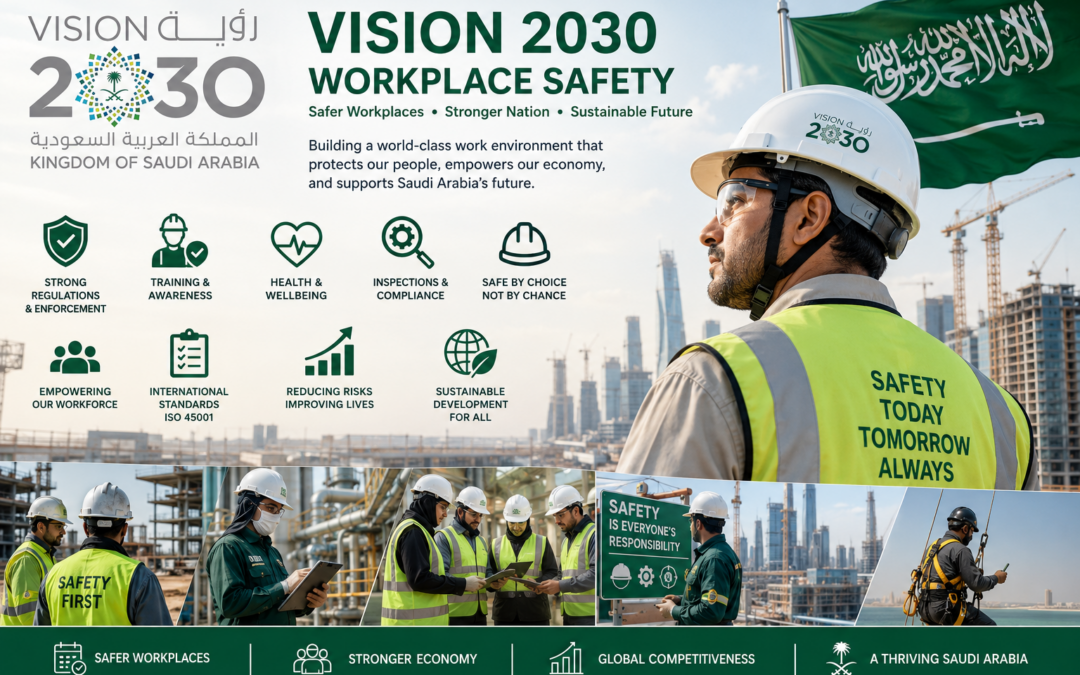
Vision 2030 and Workplace Safety in Saudi Arabia
Saudi Arabia’s Vision 2030 is not just an economic blueprint — it is fundamentally changing how the Kingdom thinks about its workforce. At the heart of this transformation is a serious reckoning with workplace safety. As the country diversifies away from oil, industries from construction and petrochemicals to logistics and healthcare are scaling rapidly. That growth brings risk. The Ministry of Human Resources has made it clear: Saudi Arabia cannot build a productive, competitive economy on the back of an unsafe workforce.
For HSE professionals, training providers, and corporate safety officers, this moment represents both a challenge and an opportunity. Regulatory frameworks are tightening, corporate expectations around compliance are rising, and Saudi nationals entering the workforce in larger numbers need structured safety education. Understanding how Vision 2030 connects to workplace safety is no longer optional background knowledge — it is essential context for every organisation operating in the Kingdom.
Workplace Safety Landscape in Saudi Arabia
Saudi Arabia has made significant strides in occupational health and safety regulation, but the data still tells a sobering story. The Ministry of Human Resources and Social Development (MHRSD) reports that workplace accidents remain one of the leading causes of workforce absenteeism across industrial sectors. The petrochemical and construction industries — both central to Vision 2030 infrastructure projects — carry the highest incident rates.
The Saudi Occupational Safety and Health (OSH) legislation, updated progressively since 2005, mandates that employers implement risk assessments, provide adequate PPE, and ensure workers receive formal safety training. Non-compliance now carries financial penalties and, in some cases, project suspension. NEBOSH’s Global Safety Report has consistently identified the GCC region as one where safety training demand outpaces current provision — particularly for mid-level supervisors and site managers who often fall through the cracks of corporate training programmes.
Several regulatory forces are reshaping the landscape right now:
- Saudisation targets under Nitaqat require employers to develop Saudi national employees — many of whom are new to industrial environments and need baseline HSE orientation.
- Giga-project requirements: NEOM, the Red Sea Project, Diriyah Gate, and other major developments require contractors to demonstrate verified safety training for all site personnel before work commences.
- ISO 45001 adoption: Increasingly, organisations bidding for government contracts must show alignment with the international occupational health and safety management standard.
- IOSH and NEBOSH recognition: Both qualifications are now explicitly referenced in tender documents issued by Saudi Aramco, SABIC, and various government ministries as acceptable proof of supervisor-level HSE competence.
The regulatory direction is clear. Safety training is shifting from a compliance checkbox to a genuine prerequisite for doing business in Saudi Arabia.
How Safety Training Supports Vision 2030 Objectives
Vision 2030’s workforce development pillar — anchored by the Human Capability Development Programme — explicitly targets the quality of Saudi workers entering technical and industrial roles. Safety training fits directly into this framework in three ways.
Workforce localisation and capability building. As Saudisation targets push companies to hire and retain national talent, those employees need structured pathways from general employment into skilled technical roles. HSE qualifications — from basic OSHA awareness through to NEBOSH IGC Saudi Arabia — provide internationally recognised credentials that make Saudi workers more deployable, promotable, and valuable. For employers, a certified workforce also reduces liability.
Reducing productivity losses from accidents. The National Transformation Programme sets measurable targets for reducing industrial incidents. Every workplace accident creates a cascade of costs: medical treatment, lost working days, investigation time, regulatory scrutiny, and reputational damage. Organisations with robust safety cultures — built on proper training — consistently outperform peers on productivity metrics. A 2023 IOSH-commissioned study across GCC industrial sites found that companies with structured safety training programmes experienced 34% fewer recordable incidents compared to those relying solely on on-the-job instruction.
Economic diversification requires safe infrastructure. The tourism, entertainment, logistics, and renewable energy sectors targeted by Vision 2030 all carry their own distinct risk profiles. Generic safety awareness is not sufficient. Sector-specific training — delivered by qualified instructors who understand local operating conditions — is what actually moves the needle on incident rates.
Serving Saudi Arabia’s Industrial Heartlands — City by City
Progressive International Training Center (PITC KSA) is a TVTC-approved training provider delivering internationally accredited HSE qualifications to organisations and individuals across the Kingdom. What distinguishes effective safety training from box-ticking is localisation — understanding the specific risk environment each city’s workforce operates in.
Jubail (الجبيل الصناعية)
Jubail Industrial City hosts some of the world’s largest petrochemical facilities. IOSH Managing Safely courses and HSE training in Jubail are consistently the qualifications of choice for site supervisors and HSE officers here. Courses accommodate shift patterns common in continuous-process industries, with options for compact delivery formats suited to operational constraints.
Dammam (الدمام)
As the Eastern Province’s administrative and commercial hub, Dammam sees demand from construction, logistics, and healthcare sectors. OSHA 30-Hour Construction and General Industry programmes draw strong attendance from project managers and site supervisors working on the region’s expanding infrastructure.
Riyadh (الرياض)
The capital’s giga-project pipeline — from urban transit to massive commercial developments — is driving demand for HSE certificates among both contractors and in-house safety teams. Arabic-medium safety training in Riyadh is particularly sought after for site-level workforces.
Jeddah (جدة)
Port operations, manufacturing, and the growing tourism and hospitality sector around the Corniche create a mixed-sector training need. IOSH Working Safely is frequently specified for non-managerial staff, while supervisors pursue IOSH Managing Safely or NEBOSH IGC.
Khobar (الخبر)
Khobar’s proximity to Jubail and its concentration of oil-sector service companies means strong demand for process safety content alongside general HSE qualifications. PITC delivers both open-enrolment and in-company training here.
Yanbu (ينبو الصناعية)
Yanbu’s refining and petrochemical complex mirrors Jubail’s risk profile. Process Safety Management modules are increasingly requested by site safety managers working within Aramco’s downstream supply chain.
Tabuk (تبوق)
NEOM and the Red Sea Project are transforming Tabuk from a relatively quiet northern city into one of the Kingdom’s most active construction zones. HSE training demand here is growing fastest of any region — particularly for construction-sector OSHA programmes and fire safety certification.
Frequently Asked Questions – Vision 2030 & Workplace Safety in Saudi Arabia
Q: What HSE qualifications are most recognised by Saudi employers?
NEBOSH IGC and IOSH Managing Safely are the two most frequently specified qualifications in Saudi tender documents and job listings. OSHA 30-Hour programmes are widely accepted in construction and manufacturing. All three are available through TVTC-approved providers operating in the Kingdom.
Q: How does Vision 2030 affect HSE training requirements in Saudi Arabia?
Vision 2030’s push for economic diversification and workforce nationalisation has directly increased regulatory scrutiny around workplace safety. Giga-projects and government contracts now routinely require verified safety training for all site personnel, driving demand for internationally accredited HSE qualifications across all industrial sectors.
Q: Is NEBOSH training available in Arabic in Saudi Arabia?
NEBOSH examinations are conducted in English, but many approved learning partners offer Arabic-medium tuition to support comprehension. This hybrid model — Arabic instruction, English examination — is well-established in Saudi Arabia and effective for candidates whose first language is Arabic.
Q: Can companies arrange in-house HSE training in Saudi Arabia?
Yes. Many organisations — particularly in petrochemicals, construction, and logistics — prefer in-company delivery for operational reasons. TVTC-approved centres can bring qualified instructors to client sites across Jubail, Riyadh, Dammam, Jeddah, Khobar, Yanbu, and Tabuk.
Q: What is the difference between IOSH and NEBOSH for Saudi professionals?
IOSH qualifications (Working Safely, Managing Safely) are shorter, more accessible entry points — ideal for supervisors and non-safety specialists needing solid foundations. NEBOSH certificates and diplomas are more in-depth and carry greater weight for dedicated HSE roles. For Saudi professionals targeting HSE officer or manager positions, NEBOSH is typically the preferred route.