WORKPLACE SAFETY — TVTC ACCREDITED TRAINING

Why BLS and First Aid Certification Is Required in KSA Workplaces

Saudi Arabia’s Labor Law requires every employer to maintain first aid coverage on-site. But for workers in oil, gas, construction, and healthcare, a personal certificate is not optional — it determines whether you get through the gate. This guide covers what the law actually requires, which industries enforce it most strictly, and how to get certified in KSA.

Saudi Labor Law Compliant

Covers all HRSD first aid requirements under Saudi Labor Law and OSHA-aligned site standards applicable across KSA industries.

AHA / SHA Certified

PITC KSA issues both American Heart Association and Saudi Heart Association certificates — accepted by every major employer and government authority in KSA.

Onsite Group Training Available

PITC KSA delivers First Aid and BLS training at your facility across Riyadh, Jeddah, Dammam, Jubail, Khobar, and all major KSA cities.
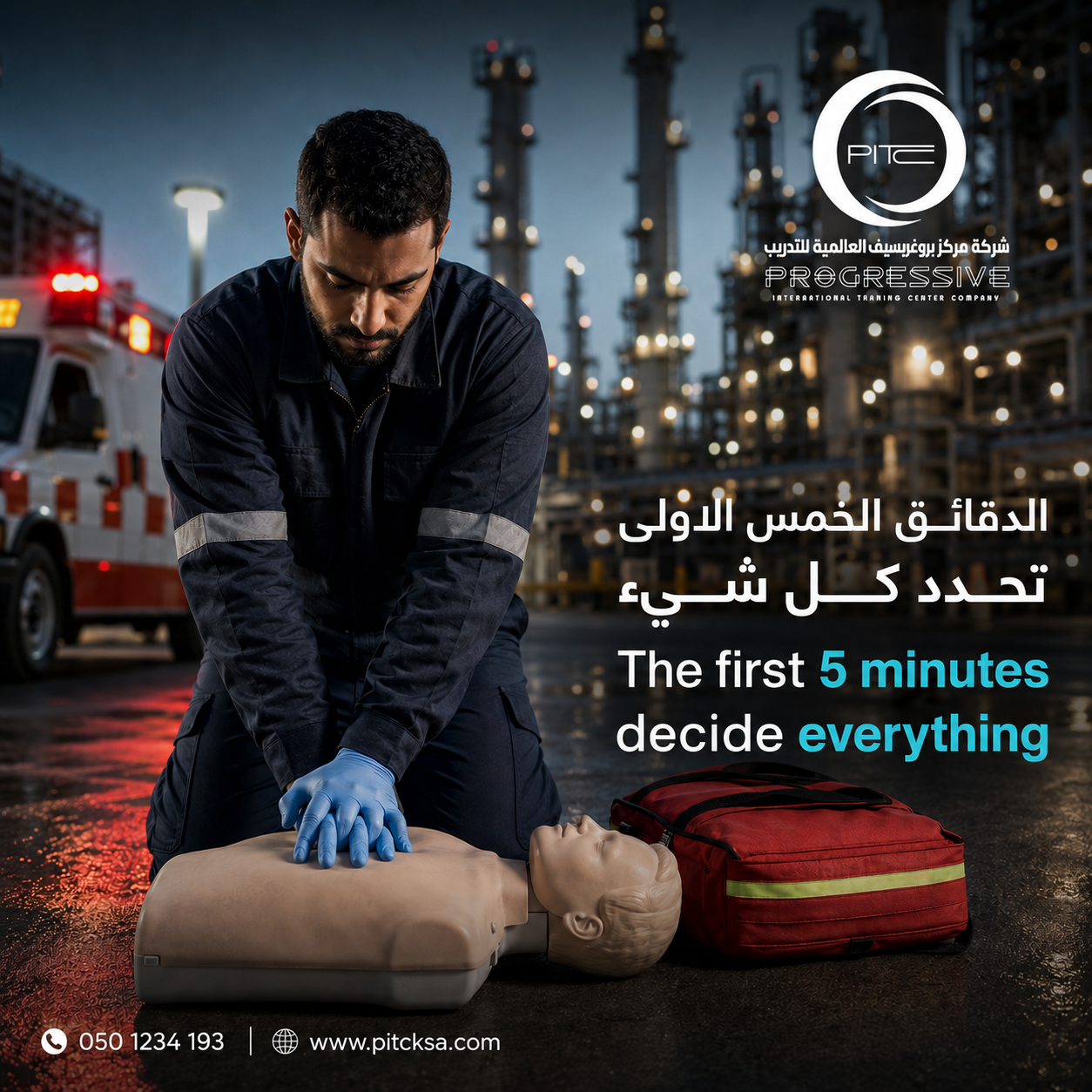
BLS and first aid training Saudi Arabia — PITC KSA certified instructors

About This Guide

Topic: BLS & First Aid — Legal Requirements

Reading Time: 8 Minutes

Audience: HSE Managers, HR, Safety Officers, Workers

Certificate: AHA / SHA — Valid 2 Years

Delivery: Onsite Nationwide KSA

Accreditation: TVTC Recognised

Professionals Trained

Corporate Clients Served

Years of Safety Training

Accreditation

TVTC

Technical & Vocational Training

THE BASICS

What Is BLS — And How Does It Differ from First Aid?

Basic Life Support (BLS) is a set of emergency techniques anyone can learn without specialised equipment: CPR, AED operation, choking response, airway management, and recognising cardiac arrest or stroke. Its defining feature is the focus on emergencies where minutes determine the outcome — acting within four minutes of cardiac arrest is often the difference between full recovery and permanent damage.

General first aid covers a wider range of situations — bleeding control, burns, fractures, heat exhaustion — but does not go as deep into cardiac and respiratory emergencies. Most Saudi training centres bundle both into a combined one-day course, which is what most employers require for compliance.

KSA Certification Bodies:

AHA (American Heart Association) — global standard, accepted by every major Saudi employer.
SHA (Saudi Heart Association) — same protocols, recognised by the Saudi Ministry of Health.
ASHI (American Safety & Health Institute) — accepted by the Saudi DHA.
All certificates are valid for two years.

LEGAL REQUIREMENTS

What Saudi Labor Law Says About First Aid at Work

The Ministry of Human Resources and Social Development (HRSD) sets the baseline under Saudi Labor Law and its implementing regulations. Non-compliance creates regulatory exposure, liability risk, and can affect Saudization standing and contractor qualification. View all PITC KSA safety courses to meet your compliance obligations.

Stocked First Aid Cabinet On-Site

Every employer must maintain one or more fully stocked medical aid cabinets at each worksite. Inspectors from HRSD check this as part of routine compliance audits — missing or expired supplies result in immediate fines.

Trained First Aider During Working Hours

At least one qualified first aider must be available on-site during every shift. For large sites — particularly in oil, gas, and construction — the ratio is typically one certified responder per 10–25 workers depending on hazard level.

Safety Instructions in Arabic

All emergency procedures, first aid instructions, and safety signage must be posted in Arabic. Multilingual workforces require additional language provisions — particularly relevant across Jubail, Yanbu, and Dammam industrial complexes.

No Cost to Workers

Employers cannot charge workers for mandatory safety training or first aid provision. The full cost — training, equipment, certification — must be borne by the business. Any contractual attempt to pass these costs to employees is unlawful.

Project Tenders Now Require Training Records

Many government and international project contracts now list first aid training as a pre-qualification requirement before work begins — not a nice-to-have. Expired or missing certificates can disqualify a bid.

Vision 2030 Is Raising the Floor

Saudi Arabia’s workplace injury rate dropped from 416 to 287 per 100,000 workers since 2018 — real progress, but the HRSD has made clear the target is lower. Inspections are more frequent, accreditation requirements are tighter, and what passed five years ago may not pass today.

SECTOR REQUIREMENTS

7 Industries in KSA Where BLS Certification Is Expected

First aid requirements vary in intensity by sector. In some industries, an expired certificate means site access is physically denied. In others, it affects licensing, tendering, or insurance coverage. Here is where enforcement is sharpest.

Oil, Gas & Petrochemicals

Saudi Aramco, SABIC, and their contractors require current first aid and BLS certification for all site-based personnel. Many high-hazard sites mandate one certified responder per 10 workers. An expired certificate means denial at the gate — no exceptions. BLS certification course

Construction

Construction has the highest injury rate of any KSA sector. HRSD regulations and OSHA-aligned site standards require first aid coverage on all active sites. Workers with OSHA 30-hour certification — which includes a first aid component — are preferred by most main contractors. OSHA 30-Hour Training

Healthcare & Clinics

The requirement extends beyond clinical staff. Saudi health authority licensing standards typically apply to non-clinical staff too — admin, pharmacy, reception. AHA BLS carries particular weight with hospital HR departments during hiring and annual compliance reviews.

Education

Schools across KSA — international, government, and TVTC campuses — are expected to have certified first aiders among staff. In some cases this appears in school licensing criteria. Schools operating under international standards include it in staff induction as a baseline expectation.

Manufacturing & Warehousing

Any facility with chemical, mechanical, or electrical hazards must have trained first aiders on-site during operating hours. This covers most industrial zones across Jubail, Dammam, Yanbu, and Riyadh — including all SABIC and SEC contractor sites.

Hospitality & Events

Large hotels, catering companies, and event venues are moving toward requiring front-line staff to hold first aid certification. Venue licensing in some municipalities is beginning to require it, and the duty-of-care exposure from not having it is increasingly understood.

Security & Facilities Management

Security personnel and facilities supervisors often need first aid certification as part of their own licensing conditions. Companies providing contracted security or managed facilities should review their licensing terms — many now include this as a renewal condition.

WHY PITC KSA

Why Safety Professionals Choose PITC KSA for First Aid Training

Nine years of delivering TVTC-accredited safety training across Saudi Arabia. Over 1,350 certified professionals. A track record built on repeat contracts from the Kingdom’s largest employers.

AHA & SHA Certified Courses

PITC KSA offers both American Heart Association and Saudi Heart Association certification. Both are universally accepted by Saudi employers, government bodies, and project owners.

TVTC Accreditation

All PITC KSA programmes carry active TVTC accreditation — the gold standard for professional certification in the Kingdom. Certificates satisfy regulatory audits and tender pre-qualification requirements.

Onsite Corporate Delivery

PITC KSA brings training to your facility anywhere in KSA — no travel disruption, no operational downtime. Group sessions are more cost-effective than individual enrollment for teams of 5 or more.

Bilingual Instruction

All courses are delivered in English and Arabic by qualified instructors with field HSE experience. Every team member is assessed in their strongest language.

9 Years in KSA

Founded and operating in Saudi Arabia for over nine years — not a fly-in operator. PITC KSA understands local regulatory requirements, industry expectations, and the specific needs of KSA workforces.

Same-Day Certification

Upon passing the practical and written assessment, participants receive their certificate the same day. No waiting, no delays — certificates are ready for use in site access and compliance records immediately.

COURSE PROCESS

How to Get BLS and First Aid Certified in Saudi Arabia

A combined First Aid and BLS course typically takes one full day. The process is straightforward — most participants complete everything, including the certificate, in a single session. Register for a BLS or First Aid course or request an on-site group programme.

Step 1: Register

Enroll online, by phone, or request an on-site programme for your team. Group bookings for 5 or more receive a dedicated scheduling slot and consolidated invoicing for HR records.

Step 2: Attend the Course

One full day covering both theory and hands-on practical training. Scenarios include CPR on mannequins, AED simulation, choking response, bleeding control, burns, and fracture management.

Step 3: Pass the Assessment

Written and practical assessment. Standard pass mark is 70%. Instructors provide immediate feedback — if additional practice is needed, it happens the same day before certification.

Step 4: Receive Your Certificate

AHA, SHA, or ASHI certificate issued same day. Valid for two years. Ready for immediate use in site access, employment records, and compliance audits. View the BLS course details

Step 5: Recertify Every Two Years

A shorter half-day recertification course keeps your certificate current. PITC KSA sends reminder notifications and offers renewal sessions at your facility on request.

Step 6: Update Compliance Records

PITC KSA issues group completion reports suitable for HSE audits, HRSD inspections, and tender pre-qualification documentation — formatted for direct submission to project owners.

RELATED COURSES

Complete Your Safety Training Portfolio with PITC KSA

First Aid and BLS certification is the foundation. These TVTC-accredited and internationally recognised courses round out the safety qualifications most commonly required by Saudi employers and project owners.

First Aid & BLS Training

Combined AHA/SHA-certified course covering CPR, AED, choking response, bleeding control, and emergency recognition. One day, TVTC recognised, valid two years. Learn more →

OSHA 30-Hour Training

OSHA 30-hour construction and general industry safety training — widely required for contractor qualification on major Saudi infrastructure and Vision 2030 projects. Learn more →

NEBOSH IGC

International General Certificate in Occupational Health and Safety. The benchmark qualification for HSE managers and safety officers across KSA and the Gulf region.

VR Fire Safety Training

TVTC-accredited virtual reality fire safety simulation. Immersive scenario-based training for fire wardens and emergency response teams — onsite delivery nationwide. Learn more →

H2S Safety Training

Hydrogen sulphide awareness and emergency response for oil and gas sector personnel. Compliant with ARAMCO and Saudi contractor requirements. Delivered at your facility.

Confined Space Entry

Authorised entrant and attendant training covering atmospheric monitoring, PTW documentation, and rescue procedures under Saudi regulations. Required for most petrochemical sites.

TVTC Accredited

PITC KSA holds active TVTC (Technical and Vocational Training Corporation) accreditation — the highest standard for professional training certification in the Kingdom of Saudi Arabia.

AHA & SHA Recognised

Certificates issued by PITC KSA are recognised by the American Heart Association and Saudi Heart Association — the two certification bodies accepted across all KSA sectors and government authorities.

9 Years Operating in KSA

Founded and operating in Saudi Arabia since 2017. Over 1,350 professionals trained. 940 corporate clients served. A track record built on repeat contracts from the Kingdom’s largest employers.

FREQUENTLY ASKED QUESTIONS

BLS & First Aid in KSA — Common Questions

Is first aid certification legally required for every worker in Saudi Arabia?

The obligation sits with the employer. Saudi Labor Law requires employers to provide first aid coverage at every worksite, including at least one trained first aider during working hours. In oil, gas, and construction sectors, site access rules mean workers practically need a personal certificate to enter site — which amounts to the same requirement.

How long does a BLS certificate last in Saudi Arabia?

Two years. Both AHA and SHA certificates expire at that point. A shorter recertification course — typically a half-day — is needed to stay current after expiry.

Which BLS certification is best in Saudi Arabia — AHA or SHA?

For most workers in KSA, either works well. AHA is the global standard and universally accepted by Saudi employers. SHA follows identical protocols and is recognized by the Saudi Ministry of Health. If working in a hospital or clinic, check with HR which they prefer. PITC KSA offers both.

Can PITC KSA train a whole team on-site?

Yes. PITC KSA delivers group BLS and First Aid training at your facility across all major Saudi cities including Riyadh, Jeddah, Dammam, Jubail, and Khobar. Contact the team with your headcount for a corporate package quote.

What is included in a combined BLS and First Aid course at PITC KSA?

The combined course covers CPR technique, AED use, choking response, airway management, bleeding control, burns, fractures, heat exhaustion, and emergency recognition. Both theory and hands-on practical assessment are included. Certificate is issued same day upon passing.

How much does first aid or BLS training cost in Saudi Arabia?

Course fees vary by type and group size. PITC KSA offers individual enrollment and corporate group packages. Contact PITC KSA directly for current pricing and group discounts.

Do I need OSHA 30 and First Aid certification together?

For workers on oil, gas, and major construction projects in KSA, yes — most main contractors require both. PITC KSA offers OSHA 30-Hour Training alongside First Aid and BLS courses, making it straightforward to complete both qualifications in one training block.

The Practical Bottom Line on BLS and First Aid in KSA

The legal requirement has been in place for years. What is changing is enforcement — more frequent HRSD inspections, stricter contractor pre-qualification requirements, and a broader expectation from project owners and regulators that a certified first aider is simply part of a properly run worksite.

For workers in oil, gas, and construction, an expired certificate means you do not get on-site. No workaround, no grace period. For employers, the exposure goes beyond fines — the absence of a trained first aider on-site becomes a factor in every incident investigation and every liability claim that follows.

PITC KSA delivers combined First Aid and BLS training at your facility across Riyadh, Jeddah, Dammam, Al Khobar, Jubail, Mecca, Medina, Tabuk, and Abha. AHA and SHA certificates. TVTC accredited. Same-day certification. If your team’s certificates are current, you are set. If they are not, the practical answer is to book a session.

Register for a BLS or First Aid course at PITC KSA →

Get Your Team BLS and First Aid Certified Today

AHA and SHA certified. TVTC accredited. Onsite delivery across Saudi Arabia. Group packages available.