
Process Safety · HAZOP in Saudi Arabia

What Is HAZOP? Understanding Hazard and Operability Studies in Saudi Arabia

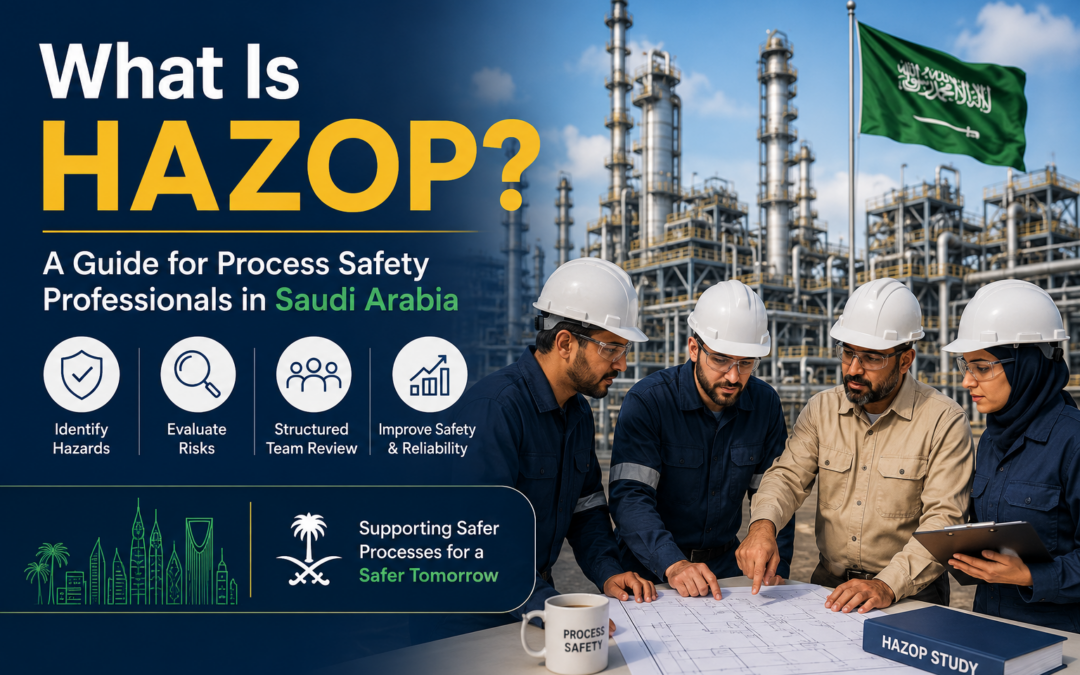
HAZOP — Hazard and Operability Study — is the structured methodology used to identify hazards and operability problems in process plant designs and procedures. Saudi Aramco, SABIC and the Royal Commission for Jubail and Yanbu all require HAZOP studies as a mandatory step in design review for new and modified process facilities. For HSE professionals and process engineers working in Saudi Arabia’s oil, gas and petrochemical sectors, understanding how HAZOP works is not optional background knowledge. It is the language that safety reviews are conducted in.

IN THIS GUIDE

  1. How a HAZOP Study Works
  2. Six Steps in a HAZOP Study
  3. Why Saudi Aramco and SABIC Make HAZOP Non-Negotiable
  4. Frequently Asked Questions
  5. HAZOP Is How Saudi Process Plants Find Problems Before They Find People

The HAZOP Methodology

How a HAZOP Study Works

HAZOP is a structured, systematic examination conducted by a multidisciplinary team. The team works through a process design, piping and instrumentation diagram (P&ID) by section, applying a set of guide words to each parameter. The guide words (No, More, Less, As Well As, Part Of, Reverse, Other Than) are combined with process parameters (Flow, Pressure, Temperature, Level, Composition) to generate deviations. For each deviation, the team asks: what could cause this, what are the consequences, and what safeguards already exist. Where consequences are serious and safeguards are insufficient, recommendations are recorded for engineering or procedural changes.

Why HAZOP exists: The methodology was developed by ICI in the 1960s following a series of process plant accidents caused by conditions that were neither foreseeable from single-discipline engineering review nor covered by existing safety standards. HAZOP forces a systematic, team-based examination that catches what individual engineers and standard-compliance reviews miss.

The HAZOP Process

Six Steps in a HAZOP Study

Define the Scope and Nodes

The HAZOP leader divides the process into nodes: discrete sections of piping or equipment with a defined design intent. Nodes might be individual pipe sections, vessel inlets, heat exchanger shells, or reaction zones. Defining nodes clearly is critical because the HAZOP analysis is conducted one node at a time.

Apply Guide Words to Parameters

For each node, the team systematically applies guide words to each relevant process parameter. For a pipe section with design intent of liquid flow: No Flow (blockage or pump failure), More Flow (control valve failure, line rupture upstream), Less Flow (partial blockage, pump degradation). Each combination that could occur generates a deviation for analysis.

Identify Causes

For each deviation, the team identifies realistic causes. Multiple causes for a single deviation are common. The team documents all credible causes, not just the most likely one.

Assess Consequences

The team identifies the consequences of each deviation reaching its end state without intervention. Consequences range from minor operability effects to major accidents involving fire, explosion, toxic release or structural failure. Consequence severity is assessed without reference to existing safeguards at this stage.

Evaluate Existing Safeguards

The team reviews what safeguards already exist that would prevent the deviation from occurring or mitigate its consequences. Safeguards include physical protection (relief valves, rupture discs, interlocks), procedural controls and operator response. The adequacy of safeguards is evaluated against the severity of the potential consequence.

Record Recommendations

Where existing safeguards are judged insufficient for the consequence severity, the team records a recommendation. Recommendations are specific and actionable: add a high-level shutdown on vessel V-101, revise procedure OP-045 to include specific operator response to low-flow alarm on FIC-202. Vague recommendations are not acceptable in a formal HAZOP.

HAZOP in Saudi Arabia’s Process Industries

Why Saudi Aramco and SABIC Make HAZOP Non-Negotiable

Saudi Aramco PHA Requirements

Saudi Aramco's Process Safety Management (PSM) programme requires a Process Hazard Analysis for any new facility, major modification, or Management of Change affecting process parameters. HAZOP is the preferred methodology for complex process systems. Aramco requires that HAZOP teams include a qualified HAZOP facilitator, process engineers, operations personnel and instrument engineers.

SABIC Engineering Standards

SABIC applies engineering standards that mandate HAZOP studies at specific design stages: typically at the Conceptual Design, Basic Engineering and Detailed Engineering phases. For major projects, independent HAZOP verification by a third-party review team may be required before detailed engineering is approved.

Jubail and Yanbu Industrial City Requirements

The Royal Commission for Jubail and Yanbu requires HAZOP documentation as part of the facility permitting process for new and modified process plants. Without a completed and actioned HAZOP, operating permits for new process facilities cannot be issued.

Insurance and Liability Implications

Saudi process industry insurers require evidence of formal process hazard analysis as a condition of property and liability coverage for high-value process facilities. A HAZOP report that documents identified hazards and implemented recommendations is the standard form of that evidence.

FREQUENTLY ASKED QUESTIONS

Frequently Asked Questions

Who should participate in a HAZOP study?
A typical HAZOP team includes: a qualified HAZOP leader/facilitator, a process engineer with design knowledge, an operations representative with hands-on plant experience, an instrument and control engineer, a safety or loss prevention engineer, and a scribe. The operations representative is often the most valuable team member because they know how the plant actually behaves.
What is the difference between HAZOP and HAZID?
HAZID (Hazard Identification) is a broader, less structured study typically conducted at the conceptual or early design stage to identify major hazard categories. HAZOP is more structured, more detailed, and is applied to completed or near-complete process designs. HAZOP generates specific engineering recommendations. HAZID generates categories of hazard for further analysis.
Is HAZOP required by Saudi law?
Saudi law does not specify HAZOP by name, but Saudi Labour Law and Ministry of Industry regulations require employers to identify and assess workplace hazards. In practice, Saudi Aramco and SABIC requirements create a de facto industry standard that makes HAZOP mandatory for process plant work in Saudi Arabia.
How long does a HAZOP study take?
It depends heavily on the complexity of the process. A simple utility system might take half a day. A complex reaction or separation system with multiple operating modes can take weeks. As a rough guide, experienced HAZOP facilitators estimate one to two hours per node for a thorough study. Under-resourced or rushed HAZOP studies are a leading cause of hazards being missed.
What qualifications does a HAZOP leader need?
A HAZOP leader needs formal training in HAZOP methodology, practical experience facilitating studies, and sufficient process engineering knowledge to understand the deviations being discussed. In Saudi Arabia, HAZOP facilitators typically hold engineering degrees with relevant process experience. Formal HAZOP leader certification programmes are available through recognised training providers.

HAZOP Is How Saudi Process Plants Find Problems Before They Find People

A HAZOP study is not a paperwork exercise. It is the mechanism by which Saudi Arabia’s most complex industrial facilities catch the hazards that single-discipline engineering review, design standards, and regulatory compliance checks all miss. Saudi Aramco did not make process hazard analysis a core PSM requirement by accident. The history of process industry accidents worldwide shows consistently that facilities without structured hazard review find their problems in the worst possible way. PITC KSA delivers process safety training for HSE and engineering professionals working in Saudi Arabia’s oil, gas and petrochemical sectors.

Related reading: What Is ISO 45001? | Permit to Work Training Saudi Arabia | How to Identify and Control Workplace Hazards

Process Safety Training for Saudi Arabia’s Industrial Sector

PITC KSA delivers TVTC-accredited safety training for process safety, HSE management and industrial operations teams across Saudi Arabia.